

AI clothing try on for online shopping decisions is useful because most cart doubt is visual, not logical. You can read the size chart three times, zoom into the model photo, check the fabric content, and still not know whether the coat feels sharp on you or just sharp on the person selling it. The hard part is not deciding whether an item is nice. It is deciding whether that color, cut, length, and volume make sense with your body, your shoes, and the clothes you already wear.
That is why virtual try on has become a serious part of fashion ecommerce coverage this fall. Recent industry reporting has focused on shoppers getting better fit information before checkout, because returns often come from ordering with product photos, size charts, and guesswork. The practical takeaway is simple: the more clearly you can picture an item on yourself before buying, the less likely you are to panic order three sizes or keep something that never leaves your wardrobe.
Use AI clothing try on before you buy the items that create the most uncertainty: coats, jeans, dresses, boots, trousers, and anything with a strong color or unusual shape. These are the pieces where a flat product shot hides the important questions. Does the coat hit where your trousers widen? Do the loafers make the jeans feel intentional or too school-uniform? Does the neckline work with the cardigan you already own? TryFits AI helps turn those vague questions into a visual check before the order is placed.
Start with the item that changes the outfit most
If you are building a cart, do not try on every plain T-shirt first. Start with the piece that will decide the outfit: the long coat, the satin skirt, the barrel leg jeans, the colored boots, or the blazer with a strong shoulder. That one item controls proportion and mood. Once you can see whether it works on you, the smaller choices become much easier.
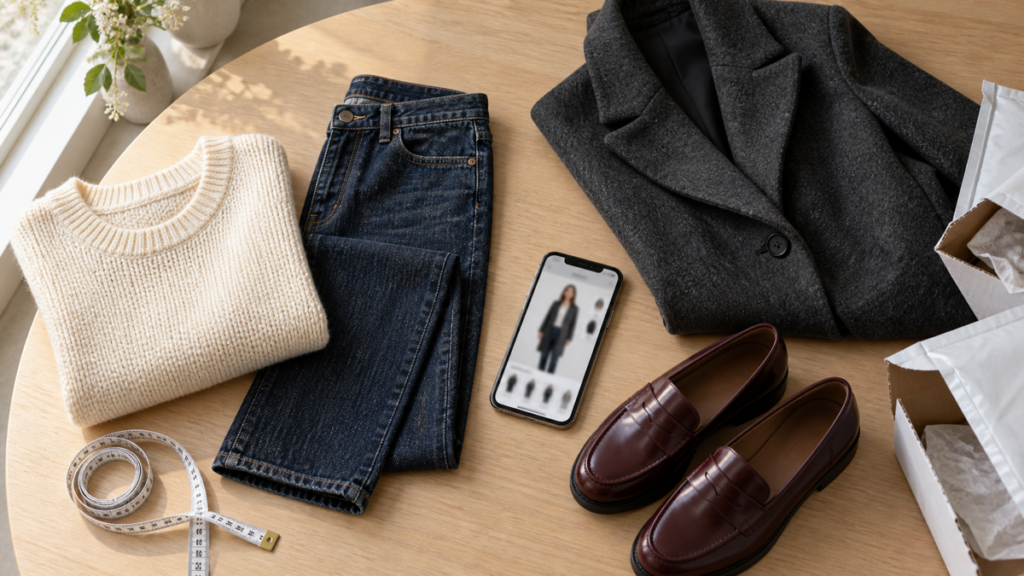
For example, a charcoal wool coat might look quiet on a product page, but on your frame it could either sharpen everything or swallow the outfit. A cream knit might brighten your face, or it might look too warm beside the coat. Burgundy loafers might pull the look together, or they might compete with a bag you already planned to use. A visual preview gives you a cleaner answer than another tab of styling inspiration.
Good online shopping is not about buying more confidently. It is about removing the items you were never going to wear.
Compare the outfit, not just the garment
The biggest mistake is asking whether one garment is cute in isolation. Most unworn purchases were cute somewhere: on the model, in the campaign, in the mirror for five rushed seconds. The better question is whether the item completes outfits you actually need. Put it against your usual jeans, your commute shoes, your winter coat, your party bag, or the dress you already know fits.
This is where AI clothing try on for online shopping decisions beats the usual screenshot folder. Screenshot folders collect desire. Try on previews test usefulness. If you are considering a fall coat, compare it with straight jeans, wide leg trousers, and the boots you wear most. If you are shopping dresses, check the length with flats and with heels. If you are choosing a bag, look at scale beside your coat rather than judging it from a cropped product photo.
- Use one base outfit you already wear often.
- Try the new item with two different shoes.
- Check one safe color and one more interesting color.
- Look at the full outfit before deciding on size or shade.
Use virtual try on to reduce return risk
Returns usually start earlier than the return label. They start when you buy something while ignoring the little doubt in your head. Maybe the hem looks too long. Maybe the sleeve shape is bigger than your usual coats. Maybe the color is gorgeous, but you do not own anything that makes it feel easy. TryFits AI is most helpful at that exact point, before the doubt turns into a parcel.
If sizing is the worry, use the preview to check proportion first, then read the size chart. A try on image cannot replace garment measurements, but it can show whether the silhouette is worth measuring carefully. There is no point agonizing over a size medium versus large if the cropped jacket length does not work with your wardrobe at all. Start with shape, then handle the numbers.
For a deeper return-focused workflow, pair this with the approach in AI virtual try on to avoid returns. If you are shopping a bigger seasonal order, the fall haul process in AI virtual try on for fall shopping hauls also helps you compare items as a group instead of treating every product page like a separate decision.
Make the final yes smaller
The best online shopping decision is often not a dramatic yes. It is a calm yes to one item because you have ruled out the weaker ones. If two coats look similar, try both with the same base outfit. If one dress color makes your shoes, bag, and jacket easier, choose that. If a trend piece only works when everything else in the outfit is perfect, leave it for someone whose wardrobe already supports it.
AI clothing try on for online shopping decisions should make your cart feel less noisy. You are not trying to predict every compliment or every photo. You are checking the evidence: proportion, color, outfit balance, and whether the piece solves the reason you started shopping. When the preview makes the outfit feel obvious, that is the item worth keeping in the basket.
Common questions
Is AI clothing try on accurate enough for online shopping?
AI clothing try on is best for checking visual decisions like color, outfit proportion, length, and styling direction. You should still read measurements, fabric notes, and return policies before buying.
What should I try on first in a shopping cart?
Start with the item that changes the outfit most, such as a coat, jeans, dress, boots, or statement color. If that piece does not work, the rest of the cart usually gets easier to edit.
Can virtual try on help me avoid ordering multiple sizes?
It can help you decide whether the silhouette is worth sizing carefully before checkout. Use the preview for shape and proportion, then use the retailer measurements for the final size decision.