


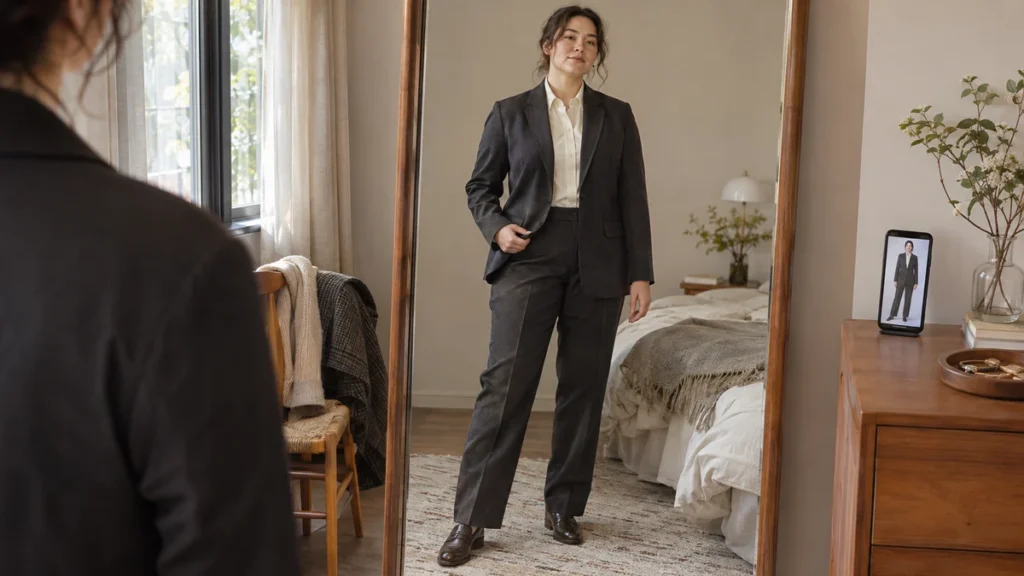
Virtual try on for matching separates can help you judge whether a jacket and trousers look convincing together on your own body. It cannot confirm that two fabrics are an exact match, even when the generated outfit looks seamless. Use the preview to assess the outfit, then use product details and a physical comparison to verify the suit.
TryFits AI describes a photo-based digital twin that lets you visualise store finds, clothing photos and outfits you describe. Its FAQ says its generative images aim to show how clothes fit, drape and fall. That makes it useful for exploring a combination, not certifying fabric identity or clothing size.
This is particularly helpful when you own half an outfit: charcoal trousers without their original jacket, perhaps, or a navy blazer you want to wear more formally. A retailer’s separate photographs leave you imagining the whole look. Seeing the proposed combination on yourself gives you a clearer question: does this read as an intentional outfit, or an almost-matching suit?
Decide whether you want a suit or coordinated separates
A matching suit needs more than a shared colour name. Fabric composition, weave, surface finish and dye can all affect how its pieces look together. Two products labelled black might appear different because one is brushed wool and the other is smooth stretch fabric.
For a conventional matching suit, look for a jacket and trousers explicitly identified by the retailer as coordinating pieces. Check the collection name and fabric description, then ask customer support if the connection is unclear. A virtual image should not override a retailer saying the items use different fabrics.
Coordinated separates give you more freedom. A navy wool blazer with mid-grey flannel trousers does not need to imitate a single cloth. The visible difference makes the combination deliberate, while a pale blue shirt and dark brown loafers keep it suitable for many offices.
Use the actual garments to explore the combination
According to the supplied TryFits AI support guide, you can work with clothing images or describe an outfit for the AI to create and put on you. For this question, actual garment references are more useful than a description alone. A prompt for a charcoal suit explores an idea; it does not identify the cloth of the jacket already in your wardrobe.
Start with a clear reference for your existing piece and the retailer’s image of the proposed purchase. Where possible, choose photographs showing the garment’s full outline without deep shadows. Keep the original product images available while reviewing the generated result, because a polished preview can make differences less obvious.
Hold the rest of the styling steady. If you are considering navy trousers for a navy jacket, use the same white shirt and black shoes throughout your assessment. Changing the shirt, footwear and jacket at once makes it harder to work out why one outfit feels more coherent.
What to inspect in the preview
Whether the silhouettes belong together
Look first at the relationship between the jacket and trouser shapes. A softly structured, slightly roomy blazer can work with straight trousers that have some movement. Very narrow trousers beneath a broad, long jacket create a different balance, which you may like, but should choose intentionally.
Ask whether you would wear the combination without calling it a suit. If the answer is yes, the pieces may still be useful even when the fabric match is uncertain. If the whole purchase depends on an invisible join between jacket and trousers, you need stronger evidence than a generated image.
Whether the styling supports the same level of formality
Try a charcoal blazer, black tailored trousers, an ivory fine-knit top and black leather loafers. The restrained palette can make separate pieces feel connected without pretending they match. For a more relaxed workplace, replace the knit with a plain cotton T-shirt, provided the dress code allows it.
Check jacket closure as a separate issue. A preview that depicts a smooth buttoned front does not prove the real jacket will close comfortably over your chosen layer. Use the physical checks in our guide to blazer buttons and pulling when the garment arrives.
Three combinations worth comparing
Navy jacket with almost-matching navy trousers
This is the combination that needs the most caution. A preview may suggest a convincing suit, but different navy dyes can become obvious in daylight. If the retailer does not identify the trousers as a match, consider mid-grey wool trousers instead, with a white Oxford shirt for a clear separates outfit.
Black blazer with black trousers
Black can still reveal differences in sheen and texture. Smooth trousers beneath a textured blazer may work as coordinated separates, especially with a cream blouse that breaks up the dark area. For a formal event requiring a suit, choose confirmed coordinating pieces rather than relying on the image to resolve the mismatch.
Brown jacket with oatmeal trousers
This pairing avoids the exact-match problem. Try a chocolate wool jacket with oatmeal twill trousers and a dark brown knit for a cold-weather office outfit. In mild weather, a cotton shirt is a practical alternative; on wet days, choose suitable leather footwear rather than assuming a smart-looking preview proves weather readiness.
Verify fabric and comfort before keeping the purchase
Once the garments are together, compare them beside a window in indirect daylight, then under the lighting where you expect to wear them. Examine the jacket sleeve against the trouser leg. Look for differences in colour, weave and shine rather than judging only from across the room.
Wear the complete outfit with your intended shirt and shoes. Sit down, reach forward and walk normally. Check waistband comfort, jacket movement and trouser length, none of which a generated result can guarantee. For the last check, see our straight-leg trouser hem examples.
Before ordering, check the return conditions and whether both coordinating pieces are available. If an exact match is essential, request fabric information or a swatch where offered. If you are happy with separates, choose a visible contrast rather than buying two near-identical colours and hoping they merge.
Common questions
Can virtual try on tell whether two navy fabrics match?
No. It can help you assess the proposed outfit visually, but it cannot certify a dye or weave match. Confirm coordinating product details with the retailer and compare the actual garments in daylight before treating them as a matching suit.
Can I preview new trousers with a jacket I already own?
TryFits AI supports clothing-photo references, according to its supplied product information. Use a clear image of your jacket and a reference for the trousers to explore the combination. Keep the originals nearby so you can spot details the generated result may have changed.
Should I buy the same size in both suit separates?
Not automatically. Choose jacket and trouser sizes separately using the retailer’s size charts and your measurements. A coordinated suit does not require identical size labels. When it arrives, check the jacket over your intended layer and test the trousers both standing and sitting.