


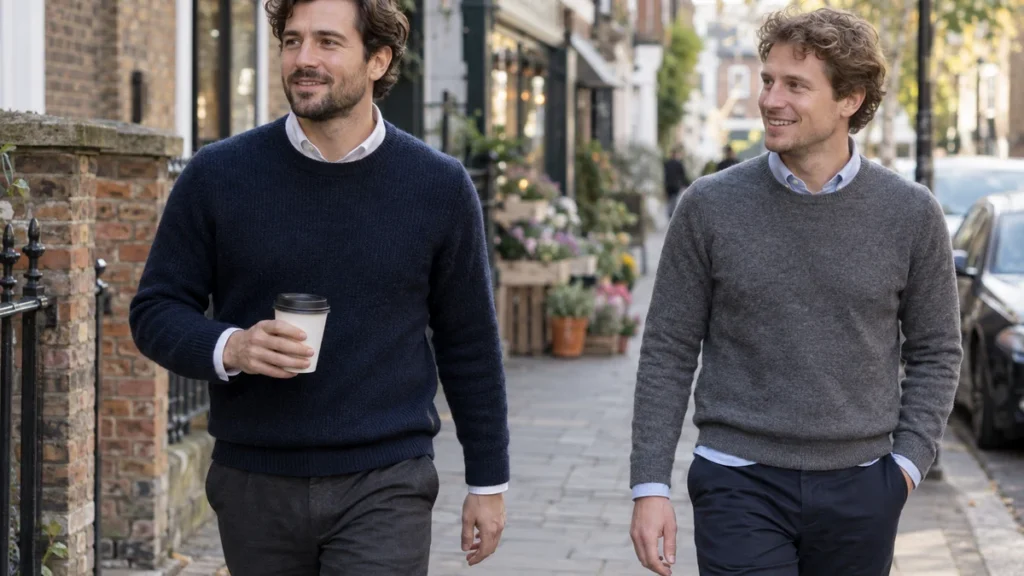
For everyday outfits, start with about 1 to 2 cm of shirt cuff showing under a jumper. That gives you a visible fabric border without making the shirt sleeve the main feature. It is a styling starting point, not a fit requirement: cuffs tucked completely inside, or a wider strip showing, can work equally well.
The useful question is what you want that border to do. A white cuff makes a navy knit look more sharply defined; a blue cuff against grey creates a quieter transition. A patterned cuff can introduce a small detail without putting a print across the whole outfit.
If you are wondering how much shirt cuff should show under a jumper, compare the same outfit with the cuffs hidden, narrowly exposed and more generously exposed. Keep the trousers and shoes unchanged. Seeing those versions on yourself, rather than on different models, makes it easier to choose the sleeve treatment you actually prefer.
Choose the cuff line, not a body-type formula
Sleeve styling is about the relationship between two garments. You do not need to classify your body or aim to make your arms appear longer or smaller. Decide whether you prefer a clean knit edge, a small contrasting border or an intentionally layered sleeve.
The supplied Healthy & Elegant guide, How to Decide Whether Two Separates Work Together, treats specific garment pairings as editorial examples rather than universal rules. Apply that approach here: the following measurements and outfits are options to compare, not standards you must meet.
A narrow reveal is a useful first choice when your collar already provides a strong contrast. A larger reveal makes sense when the cuff itself is interesting, such as striped cotton or a softly gathered sleeve. Keep the cuffs hidden when you want the jumper’s texture or jewellery to have more attention.
Check the sleeves before adjusting the styling
Put the shirt on alone and fasten its cuffs. For a conventional long-sleeved shirt, the cuff should sit around the wrist without stopping you bending your hand. Reach forward, then bend your elbows: a sleeve that pulls uncomfortably needs a fit adjustment, not a clever layering trick.
Next, add the jumper and let both sleeves settle. If the knit cuff naturally sits just above the shirt cuff, you may need no adjustment. If it covers the shirt, push it back slightly rather than pulling the shirt sleeve down until its shoulder or collar shifts.
A snug ribbed cuff usually holds that position better than a loose, stretched opening. The jumper sleeve also needs enough room for the shirt fabric underneath. Persistent bunching at the forearm is a reason to try a lighter shirt or a roomier knit; our guide to how a button-up shirt should fit covers the underlying checks.
Four outfits with different cuff treatments
A narrow white cuff with a navy crewneck
Wear a white cotton poplin shirt beneath a navy merino crewneck, with charcoal straight-leg trousers and black loafers. Start with about 1 cm of cuff showing and keep the shirt collar inside the neckline if you want the sleeve contrast to be the principal detail.
Poplin gives the cuff a crisp edge, while a fine knit lets the shirt move without excessive folds. For a cool commute, add a coat with sleeves roomy enough for both layers. Check that the coat does not push the jumper cuff forward and cover the arrangement.
A striped cuff with a relaxed weekend knit
Pair a blue-and-white striped Oxford shirt with an oatmeal cotton jumper, dark straight-leg jeans and brown trainers. Show roughly 2 to 3 cm of shirt sleeve if you want the stripes to register clearly. Leave the shirt untucked if that suits the length and your preferred silhouette.
The Oxford cloth’s texture works comfortably with the casual knit, but this combination can feel warm indoors. For a mild afternoon, choose a lightweight cotton shirt instead. If the sleeve looks crowded, reduce the cuff reveal before changing the rest of the outfit.
A tonal cuff for a quieter office outfit
Try a pale grey shirt beneath a medium-grey V-neck jumper, with black tailored trousers and burgundy loafers. A narrow cuff reveal adds a subtle change in shade rather than a bright border. You can leave the collar visible without creating a strong contrast at both the neck and wrists.
Choose smooth shirting under a fine-gauge wool knit for easy layering. If your office is warm, a sleeveless knit is a practical alternative, though it creates a different sleeve effect. With the jumper removed, the shirt and trousers should still make an outfit you are happy to wear.
A hidden cuff with a textured jumper
Wear a soft cotton shirt under a forest-green cable-knit jumper, with ecru jeans and dark ankle boots. Keep the shirt cuffs inside the knit sleeves and allow just the collar to show. This leaves the cable pattern uninterrupted at the wrists.
Hidden cuffs are particularly convenient when you are wearing gloves or doing something that requires clear wrists. Use a shirt with cuffs that sit securely rather than folding excess sleeve fabric inside the jumper. For wet weather, swap the ecru jeans for dark denim and choose boots with suitable grip.
Adjust the cuff without creating a bulky fold
For the simplest adjustment, fasten the shirt cuff and slide the jumper’s ribbing back a little. Let the knit gather naturally above the wrist. Folding a thick jumper cuff over itself creates a heavier band, which may feel restrictive beneath a coat.
If you like a turned-back shirt cuff, try it with a thin jumper and a cuff designed to fold comfortably. Turn the shirt cuff over the knit once, then check that the button and seam are not pressing into your wrist. This is a more pronounced styling choice than letting the sleeve peek out.
Make these checks before leaving:
- Reach for a bag and see whether the layers slide comfortably.
- Sit at a desk and check that cuffs do not catch beneath your palms.
- Put on your outer layer to test sleeve space.
- Wash your hands and check that the arrangement is easy to move back.
Compare colour separately from sleeve length
A bright cuff can look more prominent than a tonal cuff even when both show the same amount of fabric. Before deciding that the shirt sleeve is too long, compare a lower-contrast shirt. Cream beneath camel, or pale blue beneath denim blue, gives you a visible layer with a softer boundary.
TryFits AI can help you preview the overall colour and layering idea on your own body. Treat small cuff details as approximate in a generated image, not as a measurement or proof of sleeve fit. Confirm the final reveal with the actual garments, especially after reaching or bending your arms.
Common questions
Should shirt cuffs always show under a jumper?
No. Visible cuffs are an optional styling detail, not a requirement. Keep them hidden for an uninterrupted knit sleeve, or expose a narrow strip when you want contrast. Choose the version that feels comfortable and stays reasonably in place during ordinary movement.
Can you roll shirt cuffs over jumper sleeves?
Yes, provided the cuff folds comfortably and the jumper is thin enough. Try one turn rather than stacking several folds. If the result presses into your wrist or feels bulky inside a coat, leave the shirt cuff fastened beneath the knit instead.
What if one shirt cuff shows more than the other?
Let both sleeves settle, then gently adjust the jumper cuffs. Check whether a watch is holding one sleeve higher or a shirt cuff is fastened differently. Small differences during movement are normal; avoid repeatedly tugging the shirt down just to keep both sides perfectly identical.