


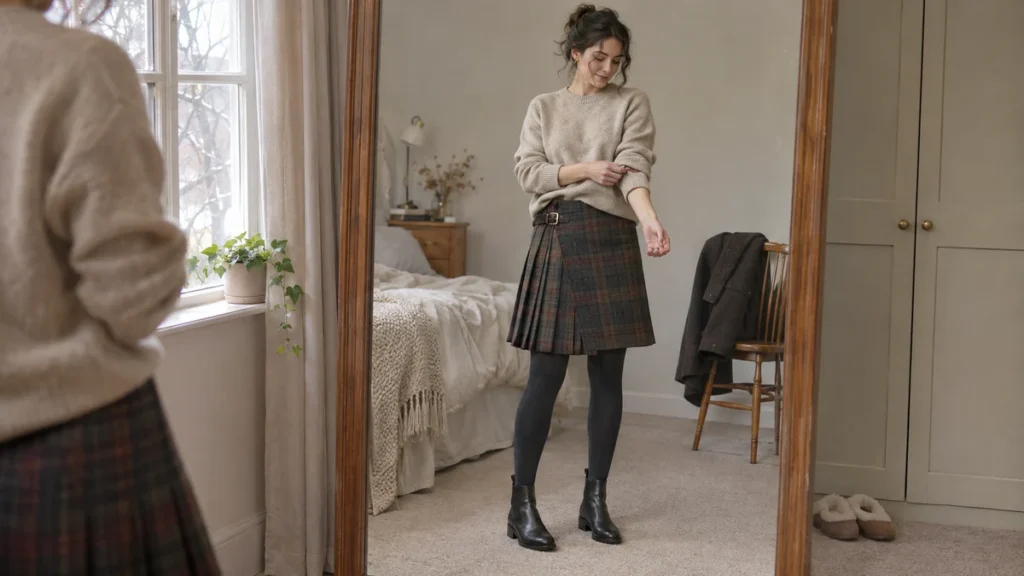
If you are wondering how to style a kilt skirt for everyday winter wear, start with a plain fine-knit jumper, opaque tights and practical ankle boots. Let the wrap front, pleats or buckle provide the detail, rather than adding a matching checked scarf. You can build the outfit around basics you already own.
The current signal comes from Woman & Home’s fashion coverage of Alex Jones wearing a Boden kilt, which identifies the kilt-inspired skirt as a seasonal trend. That supports trying the silhouette, not assuming every checked skirt is suddenly fashionable. Here, the focus is the everyday fashion skirt, rather than traditional Highland dress with its own conventions.
The useful question is how much structure you want around those pleats. The same skirt can feel quite different with a close-fitting jumper, a loose sweatshirt or a long coat. Compare those combinations on yourself before buying another top: often, changing the hem length does more than adding accessories.
Choose the skirt by its construction, not just its check
A kilt-inspired skirt usually borrows some combination of an overlapping front panel, side fastening and pleats. Look at where those features sit. A smooth front with pleats concentrated at the side or back gives you a quiet area for a jumper hem, while pleats across the front create more movement.
For an easy starting point, choose a knee-length or midi skirt in a muted check. Charcoal with burgundy, navy with forest green, or brown with cream gives you several colours to repeat elsewhere. A plain charcoal version is a good alternative if you like the construction but rarely wear patterns.
Check the fastening while sitting, walking and taking a long step. A decorative buckle does not necessarily secure the overlap underneath. Look for a reliable inner button or fastening, and make sure the front panel provides the coverage you want without needing constant adjustment.
Build three outfits around clothes you already wear
A charcoal jumper and boots for a working day
Pair a navy and green midi kilt skirt with a charcoal merino crewneck, black opaque tights and black leather ankle boots. Choose a jumper that finishes around the upper hip, or tuck a thin hem into the waistband. This leaves enough of the smooth front panel visible to show the skirt’s construction.
Add a straight wool coat in charcoal or navy and a simple leather tote. Keep the boots relatively plain if the skirt has prominent metal buckles. For a conservative workplace, choose a securely fastened overlap with modest coverage when seated, and avoid a hem that trails on stairs.
A sweatshirt and trainers for the weekend
Wear a brown checked knee-length skirt with an oatmeal sweatshirt, dark brown tights and cream trainers on a dry day. A sweatshirt with a firm ribbed hem gives you an adjustable stopping point: fold the rib under once if it covers most of the skirt’s front panel.
Finish with a short padded jacket that leaves some pleating visible. If the combination feels too school-uniform-like for your taste, swap the crewneck sweatshirt for a plain zip-neck knit and leave off knee socks. You are changing the outfit’s references, not following a rule about who can wear pleats.
A dark knit and tall boots for dinner
Try a burgundy and charcoal midi skirt with a black fitted mock-neck and black knee-high boots. The knit’s smooth surface gives the check room to stand out. Small silver earrings can echo a silver buckle without introducing another focal point.
Choose a skirt hem that passes over the boot shaft without catching on it. If the overlap bunches with every step, switch to a slimmer boot shaft or ankle boots with tights. Our guide to whether boots should overlap a midi skirt offers more examples of that junction.
Adjust the jumper hem before changing the whole outfit
A full tuck works best with a lightweight knit and a waistband that remains comfortable with the extra fabric inside. Try an untucked hem with a heavier jumper. Position it above the point where the pleats open, if possible, so the knit does not sit across their widest movement.
With a shorter skirt, a longer jumper can be a deliberate choice, but leave enough skirt visible to show the pleating. With a midi, try a waist-length cardigan buttoned as a top. Neither combination needs a belt unless the skirt is designed for one.
Take a front and side photo in your usual shoes, then change only the top length. A virtual preview can also help compare the broad proportions, but it cannot establish whether a buckle presses into your waist or the overlap stays secure. Check both in the physical garment.
Make the fabric and footwear work for winter
A substantial wool or wool-blend skirt is a useful cold-weather option, but inspect the lining and care label. Coarse fabric may feel uncomfortable against bare skin, while an unlined skirt can catch on tights. A smooth lining or separate slip can help the skirt move more freely.
For wet commutes, choose boots with suitable grip and keep the hem clear of puddles. Save suede footwear and floor-skimming lengths for dry conditions. A knee-length skirt with warm tights may be more practical than a long skirt that absorbs water at the hem.
In milder weather, switch the wool jumper for a cotton knit and use loafers with socks. Keep the socks plain when the check is busy. For warmer indoor venues, a removable cardigan over a short-sleeved top gives you more control than one very heavy jumper.
Use colour without buying a matching set
Pick one quieter colour from the check and repeat it in your top. A cream line can connect to an ivory jumper; a dark blue ground can connect to navy outerwear. You do not need an exact match, especially when the fabrics have different textures.
If every piece feels dark and dense, introduce one lighter surface near your face, such as a pale grey knit. For more combinations, see our guide to balancing dark tops with lighter separates; its colour-balance approach also works when the lighter piece is a skirt.
Common questions
What top should you wear with a kilt skirt?
Start with a plain crewneck, mock-neck or waist-length cardigan. Fine knits are easy to tuck without crowding the waistband. With a heavier jumper, try an untucked hem that leaves the skirt’s fastening and some pleating visible.
Can you wear a kilt skirt with trainers?
Yes. Pair a knee-length or midi version with simple trainers and a sweatshirt or cotton knit. Repeat a neutral from the skirt in the shoes or top. On wet winter days, replace the trainers with boots that offer suitable grip.
How do you stop a kilt skirt opening when you sit?
Choose a skirt with a generous overlap and a secure internal fastening. Sit and take a long step during the fitting check. If it still opens beyond your preferred coverage, choose another size or construction, or ask a tailor about a discreet additional fastening.