


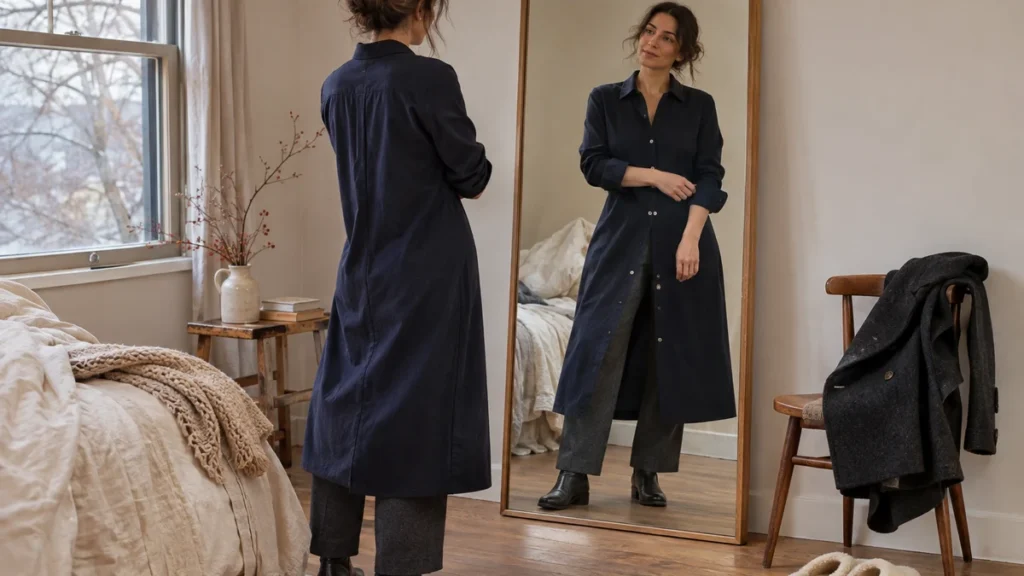
Learning how to wear a dress over trousers starts with a button-front shirt dress, straight trousers and shoes that remain visible beneath the hem. Leave the lower dress buttons open so the trousers look intentional. Keep the first combination simple: a navy shirt dress, charcoal trousers and black ankle boots.
This is a practical way to interpret the renewed focus on styling familiar clothes. Vogue’s Fall/Winter 2026 trend report, published November 9, identifies “the power of styling” through reworked staples, unexpected pairings and personal accessories. Dress-over-trouser outfits are our application of that broader direction, rather than a claim that Vogue names this exact combination as a separate trend.
The challenge is judging two hemlines together. A dress that works beautifully alone can overwhelm trousers, while trousers that suit a short top can disappear beneath a skirt. Before buying anything, compare the complete silhouette on yourself: dress open versus closed, straight versus wider trousers, and both versions with your actual winter shoes.
Choose a dress with an adjustable opening
A woven shirt dress is the easiest starting point because its buttons let you control how much trouser shows. Choose one that opens comfortably over your hips without stretching across the seat. A hem near the knee or mid-calf gives you room to experiment without dragging fabric around your ankles.
Button the dress securely through the torso, then leave it open from around the upper thigh or wherever movement feels comfortable. The opening should reveal the trousers as you stand, not only when you walk. If the front pulls into horizontal lines, release another button rather than tightening a belt over the tension.
A side-slit tunic dress also works, especially in fluid crepe or lightweight wool. Avoid assuming every summer dress will layer successfully: a stiff, full cotton skirt can bunch against trouser pockets, and a close-fitting slip may catch on seams. Start with garments that already skim rather than grip.
Match the trousers to the dress fabric
Use smooth, relatively flat trousers beneath a lightweight dress. Straight wool-blend trousers, fluid tailored styles and dark straight jeans are useful options. Large cargo pockets, bulky waistbands and thick pleats can create ridges under finer fabric, even when the colours work perfectly together.
The dress should move independently of the trousers. Try walking across the room, turning and sitting: if the skirt keeps climbing or twisting, the fabrics may be catching. Static-prone combinations sometimes need a different underlayer or fabric pairing; a visual preview cannot establish how two surfaces will behave against each other.
For your first outfit, choose trousers with a moderate leg width. You want a visible column beneath the dress without several folds collecting at the shoes. Wide trousers can work later, but a full skirt and generous trouser leg together require more attention to hem clearance and coat volume.
Three winter outfits that make the layers readable
A shirt dress with charcoal trousers for work
Wear a navy cotton-poplin shirt dress over charcoal straight trousers with black leather ankle boots. Open the dress below the hip, keeping the upper buttons closed to your preferred neckline. A narrow belt can secure the dress if you want definition, but leave enough ease to sit without the placket pulling.
For a cold commute, add a fine merino base layer underneath and a roomy wool coat. Indoors, the crisp poplin keeps the combination structured without requiring a blazer. If your dress has deep side slits, check the view from both sides so the waistband and pockets look deliberate rather than accidentally exposed.
A printed midi dress with dark jeans for weekends
Choose a small-scale printed button-front midi dress, dark straight jeans and weather-appropriate Chelsea boots. A burgundy print against indigo gives the layers enough separation without introducing several competing colours. Leave the skirt open below the waist or upper thigh, with secure coverage above.
Use jeans without heavy distressing or bulky turn-ups initially, so the dress remains the main detail. A short jacket works well if it clears the dress opening and allows the skirt to move. In persistent rain, swap a long, absorbent dress for a shorter washable version that stays away from wet pavements.
A crepe tunic dress with fluid trousers for dinner
Pair a chocolate crepe tunic dress with matching or closely related fluid trousers and almond-toe boots. Side slits reveal the trouser movement while the similar colours make the outfit feel connected. Choose sleeves that fit comfortably beneath your coat rather than adding a second dramatic shape.
Add one visible accessory, such as silver earrings or a cuff worn clear of the sleeve. You do not need a belt, necklace and statement bag to prove the outfit is styled. If the dress is sleeveless, a fine-gauge roll neck underneath is a useful winter alternative, provided the armholes do not pinch over it.
Adjust the hems, shoes and coat together
Check trouser length while wearing the intended shoes. The hem should clear the ground, and the dress should leave enough trouser visible to explain the layering. If only a narrow strip appears beneath a nearly ankle-length dress, open the front further or choose a shorter dress rather than accepting an accidental-looking sliver.
Boots are convenient for winter, but their shape matters. A neat shaft usually sits more easily beneath straight trousers than a wide, rigid one. A sturdy rounded toe gives a casual outfit weight; an almond toe keeps a fluid evening combination streamlined without requiring a high heel.
Finish by checking the coat closed as well as open. If the dress gathers inside it, choose roomier outerwear or reduce the fabric underneath. For longer outer layers, the guidance on wearing a long coat with wide leg trousers offers another way to assess the overall outline.
Compare one change at a time
TryFits AI can help you preview a dress-and-trouser combination on your own image before committing to another purchase. Keep the dress constant and compare two trouser shapes first. Then compare shoes, so you can identify which change improves the outfit rather than evaluating several unfamiliar pieces at once.
Treat the result as a visual styling aid, not proof of fit, warmth or comfortable movement. Check the real outfit for waistband pressure, static and fabric catching, then sit down with the coat on. The most useful version is one you can wear through your actual day without repeatedly adjusting the layers.
Common questions
Can you wear a dress over jeans in winter?
Yes. Start with dark straight jeans and a button-front dress that opens enough to show them clearly. Choose boots that fit beneath the jeans, and keep both hems away from wet ground. Smooth denim is easier beneath a dress than heavily embellished styles.
What length dress works best over trousers?
Knee-length and mid-calf dresses are accessible starting points, particularly with front openings or side slits. Check how much trouser remains visible while standing. A longer dress needs a more generous opening to prevent the trousers looking like an unintended underlayer.
Can you wear a loose dress over wide trousers?
Yes, but begin with a fluid dress rather than a stiff, full skirt. Keep the trousers clear of the floor and reveal their shape through an opening or side slit. If the outfit feels cumbersome, replace either layer with a straighter cut before adding accessories.