


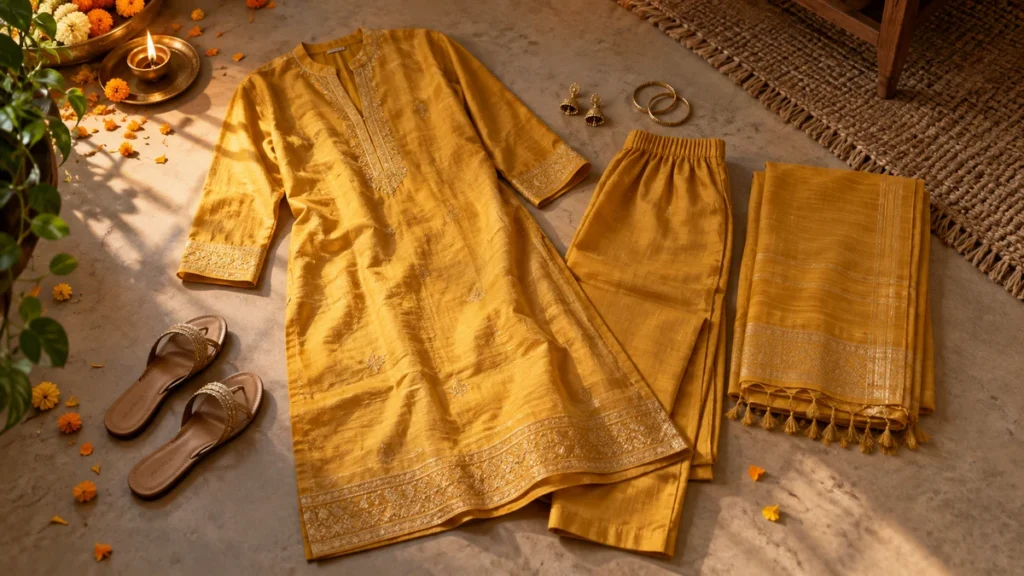
If you are wondering what to wear to a Diwali puja at home in 2026, start with a festive outfit you can sit, stand and move in comfortably. A silk or cotton silk kurta set, an anarkali with a manageable hem, or a saree you know how to drape are all sensible choices. Add footwear you can remove easily if your host asks guests to leave shoes at the door.
Diwali falls on Sunday, November 8, 2026, but your invitation may be for another evening. Check the time, address and any dress guidance before planning around that date. A puja in someone’s home may include time seated on the floor, followed by food and conversation, so the outfit needs to work beyond its first photograph.
The tricky part is often choosing between pieces that look equally good standing up. A long dupatta can slip forward when you bend, a fitted skirt can restrict sitting, and an elaborate sleeve can brush against food or decorations. Think through those movements before settling on the most ornate option.
Choose a festive outfit that moves with you
A straight kurta with relaxed trousers is an easy starting point. Try a deep teal, marigold or wine kurta in cotton silk, with trousers that have enough room at the knee for sitting. A lightweight dupatta adds occasion without requiring heavy embroidery; drape it over one shoulder and secure it discreetly if it tends to slide.
For a dressier invitation, choose an anarkali with a soft lining and a hem that clears your shoes. A gently flared shape gives you room to sit without the volume of a very full skirt. If the neckline or sleeves have embellishment, keep the dupatta simpler so the outfit does not feel crowded around your face and shoulders.
A saree is a lovely choice if you already feel confident wearing one. Pre-pleat it carefully, check that the pallu stays in place when you sit, and choose a secure blouse that does not need repeated adjustment. A lighter silk blend or crepe may be easier to manage in a compact living room than a stiff, heavily bordered fabric.
There is no need to buy traditional clothing solely because it appears in an outfit guide. If the invitation does not specify attire and you are unsure what is appropriate, ask your host. A polished long dress with covered shoulders, or tailored trousers with a festive blouse, may suit some gatherings, but the host’s guidance is more useful than a universal rule.
Plan for the setting, not just the dress code
At-home celebrations vary. One family may keep the gathering small and informal; another may dress for a full evening of guests and photographs. The invitation’s wording is your best clue. If it says festive or traditional attire, reach for your richer fabrics and jewelry. If it is a casual neighborhood gathering, a neat kurta set with subtle earrings can feel more at ease than a heavily embellished outfit.
Ask whether shoes come off indoors if that affects your choice. Embellished juttis or low block heels can finish the look for travel, while socks or bare feet may be what you wear inside. If you expect to stand for a while, avoid a brand-new pair that pinches. Pack a small bag for shoes if you will be carrying them into a crowded entryway.
Consider sleeves and trailing fabric around candles or diyas. Secure loose cuffs and keep a long dupatta away from flames. This is a practical reason to favor a narrower sleeve or a pinned drape, not a reason to strip the outfit of personality. Earrings, color and texture can carry plenty of celebration.
The weather depends on where you are celebrating. In a warm climate, breathable cotton silk or a lighter weave helps in a room full of people. In a cooler city, add a fine knit under a long outer layer for the journey, then remove the coat indoors. If you need more ideas for making layers sit comfortably over a festive look, see our guide to using virtual try on for layered outfits.
Build one of three reliable combinations
- For a small family puja: A jewel-toned straight kurta, coordinating relaxed trousers, a light dupatta, small gold-toned earrings and easy-off flats. Look for a smooth sleeve that will not catch on serving dishes.
- For a dressier evening: An embroidered anarkali in plum or emerald, a plain dupatta, low block heels and one substantial pair of earrings. Choose a hem that will not drag when you move between rooms.
- For a mixed dress code: Wide-leg tailored trousers, a long silk-blend tunic in saffron or midnight blue, delicate jewelry and polished flats. Ask the host first if you are uncertain whether this fits the gathering.
Use the combinations as starting points rather than shopping lists. A kurta you already own can look different with a contrasting dupatta or a pair of earrings you usually save for evenings. If you are deciding between a fitted and a relaxed bottom, sit down in both before choosing. The more comfortable option is often the one you will stop thinking about once the gathering begins.
Color can help you signal festivity without adding weight. Marigold with cream feels bright, emerald with antique gold looks rich, and deep pink with chocolate brown is softer than a head-to-toe metallic look. If your outfit has dense embroidery, repeat just one color from it in a bag or shoe rather than matching every detail.
Check the full outfit before the day
Try the complete look with the underlayers, shoes, jewelry and outerwear you will actually use. Sit on a chair and, if appropriate for your plans, on the floor. Lift your arms, bend to pick something up and walk a short distance. These small checks reveal slipping dupattas, tight waistbands and hems that catch underfoot.
If you are comparing pieces online, a virtual try on can help you judge the overall color balance and proportions on yourself before buying. Compare, for example, a plain teal kurta with an embroidered one while keeping the same trousers and dupatta. Then confirm garment measurements, fabric composition and return terms separately; an image preview cannot guarantee fit, texture or comfort.
Set aside a few practical extras: a small pin for a dupatta, a compact comb, and a bag that leaves your hands free. Avoid overpacking or adding jewelry at the last minute simply because the occasion is festive. A secure, comfortable outfit lets you focus on your host and the gathering rather than adjusting your clothes.
Common questions
Can I wear black to a Diwali puja at home?
Preferences vary by family and event. If you are considering black and the invitation gives no guidance, ask your host. A brighter color is an easy choice when you would rather not risk a mismatch, but there is no single rule for every household.
Do I need to wear a saree to a Diwali puja?
No. A kurta set, anarkali or another outfit approved by your host can work well. Choose a saree if you enjoy wearing one and can move comfortably in it, not because you assume it is required.
What should I wear if the celebration is outdoors before moving inside?
Choose the indoor outfit first, then add a removable coat or shawl for the journey and outdoor portion. Check the local forecast near the date, protect delicate footwear from wet ground, and make sure any extra layer does not snag embroidery or pull your dupatta out of place.