


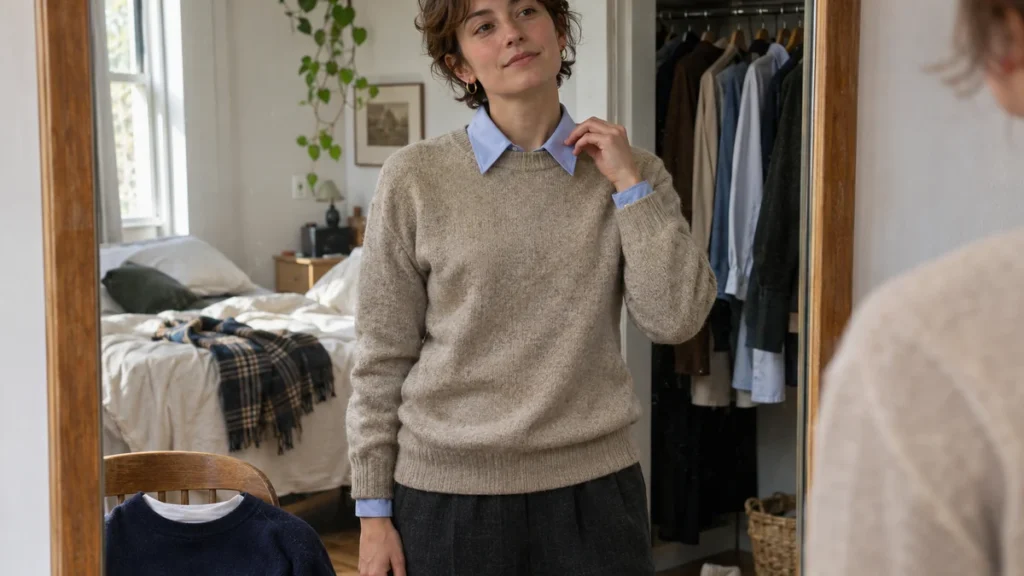
Should you wear your shirt collar inside or outside a jumper? Start with the collar’s construction: a soft, compact collar usually sits comfortably inside the neckline, while a firm pointed collar is easier to arrange outside a crew neck. Neither position is compulsory. Choose the one that stays comfortable and gives you the amount of shirt detail you want.
The useful question is not whether a collar suits your body. It is whether the shirt and jumper have enough room to sit together. A collar that keeps folding, a neckline that catches underneath it, or a shirt fastening that presses against your throat needs a practical adjustment.
Compare the same outfit with the collar tucked in, then brought out. Keep the trousers, shoes and shirt buttons unchanged so you can judge just the neckline. A full outfit view, whether in a mirror or a virtual preview, makes it easier to see whether that small collar detail deserves more or less attention.
Match the collar position to the jumper neckline
A crew neck creates a continuous curved edge. Bringing both collar points outside adds two angular shapes above it; leaving them inside keeps the neckline quieter. If the opening presses the collar into your neck, choose a roomier neckline rather than repeatedly pulling the shirt into place.
A V-neck already leaves space for the shirt collar and upper placket. Let the collar sit naturally within the opening before deciding whether its points need to come over the knit. With a shallow V, compact points are easier to accommodate than a large spread collar.
With a roll neck, leave a conventional shirt collar underneath only if it lies comfortably without stacking tightly around your throat. For visible shirt detail, cuffs or a hem may be easier. A collarless shirt is another option when you want the woven layer without extra fabric at the neck.
Check the layers before changing the styling
GetWardrobe’s outfit principles describe colour, lines and proportion as different ways to assess combinations, rather than one universal formula. The University of Kentucky’s Wardrobe Strategies guide also emphasises garment fit over the size label. Applied here, start by checking whether the layers fit together before treating a shifting collar as a styling problem.
Put on the shirt alone and move your arms forward. Then add the jumper and repeat. If the shirt pulls across the upper back or the jumper restricts your shoulders, changing the collar position will not resolve that tension.
Lightweight cotton poplin makes a crisp outline beneath fine merino, but its creases can show through close-fitting knitwear. Cotton Oxford has more texture and substance, so it pairs comfortably with a roomier wool jumper. Brushed cotton offers a softer, casual finish, although two thick layers may feel warm indoors.
Five ways to arrange the collar
1. Outside a crew neck for a clear office neckline
Wear a pale blue pointed-collar shirt under a navy merino crew neck, with charcoal straight trousers and black loafers. Bring both collar points over the neckline and smooth the back collar above the knit. The blue creates a visible border without requiring a necklace.
Choose a jumper opening that lets the collar emerge without stretching. If the points repeatedly spring upwards, try a smaller collar or a slightly wider neckline. For a cold commute, add a wool coat with enough shoulder room for both layers.
2. Inside a sweatshirt-style knit for a relaxed weekend
Pair an ecru cotton shirt with a grey, relaxed crew-neck jumper, dark indigo jeans and brown lace-up boots. Keep the collar points inside, allowing just the upper collar edge to show. This gives the outfit a woven-shirt detail without a prominent pointed outline.
A soft collar works better here than a very stiff one that pushes against the knit. Leave the top shirt button open if that feels comfortable, then check that the neckline does not catch between the collar and placket. A cotton knit suits mild weather; choose wool when temperatures drop.
3. Naturally framed by a V-neck for everyday tailoring
Try a white Oxford shirt, chocolate V-neck jumper, olive tailored trousers and dark brown loafers. Leave the top shirt button undone and let the collar settle within the V. There is no need to pull every centimetre of collar fabric over the jumper.
The open neckline already makes the shirt visible, so keep any necklace clear of the collar points to avoid tangling. If the combination feels too formal, replace the tailored trousers with washed straight-leg jeans. Our guide to mixing sporty and tailored clothes offers more ways to adjust that balance.
4. Outside a textured jumper for deliberate contrast
Combine a burgundy cable-knit jumper with a cream shirt, black corduroy trousers and black ankle boots. A moderately firm collar can remain distinct against the raised knit. Bring the points outside, then check that they lie flat rather than resting awkwardly on a cable ridge.
Keep the shirt lightweight because cable knit already contributes substantial fabric. If the neckline becomes crowded under a scarf, wear the collar inside for the journey and rearrange it indoors. Choose boots with reliable grip for wet pavements, and keep trouser hems clear of the ground.
5. One collar shape repeated through an evening outfit
Wear a black pointed-collar shirt beneath a black fine-knit jumper, with an aubergine satin midi skirt and flat leather boots. Put the collar outside so its woven texture remains visible against the knit. The tonal pairing makes the outline subtler than a white collar against black.
Choose a smooth shirt without bulky chest pockets if you want an even surface beneath the jumper. A dark denim skirt is a practical alternative for a less dressy setting. For colder weather, add opaque tights and an insulated outer layer rather than relying on the fine knit alone.
Make the collar stay where you put it
Fasten a button-down collar’s small buttons before adding the jumper, then see where the points naturally land. Do not stretch them over a neckline they cannot comfortably reach. Follow the shirt’s care label when pressing, and avoid applying direct heat to delicate knitwear while arranging the layers.
After dressing, turn your head, sit down and put on your coat. If you keep adjusting the collar, change its position or change one layer. Check the cuffs separately too: how much shirt cuff should show under a jumper addresses that detail without requiring the collar and cuffs to have identical visibility.
Common questions
Can you leave a shirt collar inside a crew-neck jumper?
Yes. A soft collar can sit inside with only its upper edge visible. Make sure the jumper opening does not force the collar against your throat or create uncomfortable folds. If it does, try a wider neckline.
Should you button the top shirt button under a jumper?
Only if you like the closed neckline and it feels comfortable. Leaving it undone creates a more open arrangement, especially with a V-neck. Test both while seated, because pressure around the neck can change when you move.
How do you stop shirt collar points curling over a jumper?
Press the collar according to its care label and use collar stays if the shirt has designated pockets for them. If the points still curl, try a softer neckline or leave them inside. Avoid forcing a stiff collar over a tight opening.