


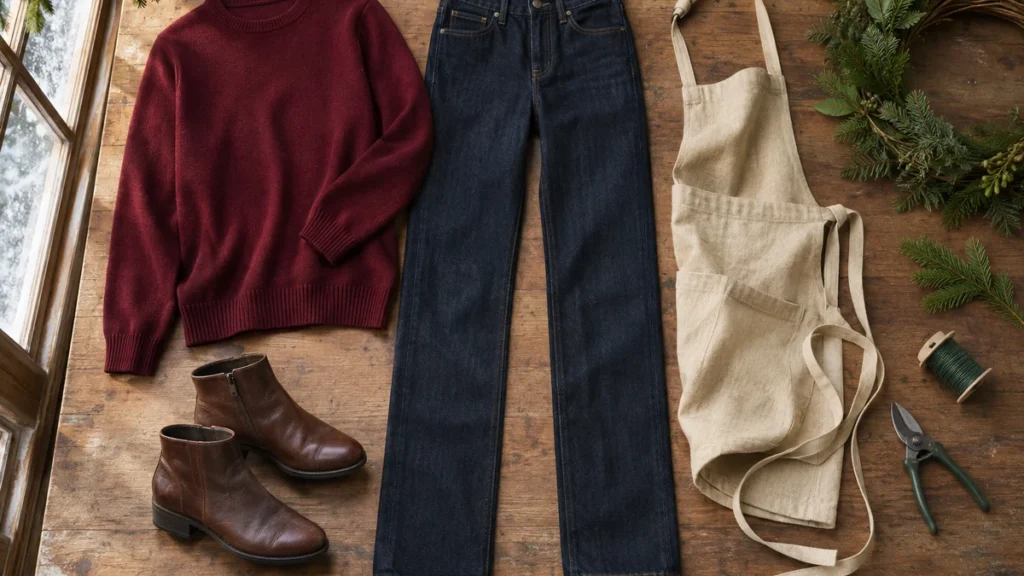
If you are deciding what to wear to a Christmas wreath making workshop, start with washable straight leg trousers, a fine cotton knit or close-cuffed shirt, and comfortable closed-toe shoes. Add an apron if the organiser provides one, and choose sleeves that stay clear of foliage, wire and your work surface. A burgundy jumper with dark jeans and leather ankle boots looks festive without getting in the way.
For a workshop booked between 12 and 26 December 2026, the practical challenge is dressing for both the journey and the activity. You might arrive in a winter coat, then spend the session standing at a table in a heated room. Check your booking for the venue, any outdoor working areas and clothing instructions before choosing layers.
The outfit also needs to work once your coat comes off. A chunky jumper can overwhelm an apron, while a long cuff can trail across damp greenery. Before buying anything, compare a shorter knit with a tucked shirt over the trousers you already own: the useful question is which combination looks right on you and leaves your hands free.
Build the outfit around the work surface
Start with sleeves. A narrow ribbed cuff, a shirt sleeve secured above the wrist or a bracelet-length top is easier to manage than a bell sleeve. Avoid relying on sleeves that need pushing up every few minutes, especially if you will be wearing gardening gloves.
Choose a top that lets you reach forward without pulling across your shoulders. A cotton crew neck with a little room through the upper arm is a reliable option. If you prefer a shirt, try reaching both hands forward before leaving home: the buttons should remain closed comfortably, and the back should not restrict movement.
Leave fluffy statement knits and delicate openwork at home. Loose fibres and open stitches can catch on twig ends or wire, while brushed fabrics can collect small pieces of foliage. Smooth cotton jersey, tightly knitted cotton and washable woven shirts are more manageable choices. Follow the garment’s care label rather than assuming every knit can go in the washing machine.
Three outfits for different workshop settings
For a florist studio or community hall
Wear a forest-green cotton jumper with dark indigo straight leg jeans and flat leather ankle boots. Choose a jumper ending around the upper hip so there is little excess fabric beneath an apron. Small stud earrings supply a finished detail without swinging forward as you work.
Dark denim is practical, but it is not stain-proof. Avoid your most precious pair, and choose a waistband that feels comfortable when you sit or lean over a table. If jeans feel restrictive, substitute washable cotton twill trousers with an elasticated back and a straight leg.
For a workshop followed by lunch
Try a burgundy close-cuffed shirt, charcoal tapered trousers and rubber-soled loafers. Wear a washable fitted T-shirt underneath if the room temperature is uncertain. A compact cardigan can come off during the workshop and go back on for lunch without requiring a complete outfit change.
The supplied Who What Wear feature, Not a Sequin in Sight: These 8 Holiday Outfits Are the Definition of Understated Chic, offers a relevant styling direction: holiday dressing without sequins. For this hands-on occasion, translate that into a rich colour and neat accessories rather than fragile embellishment. Save a silk scarf for afterwards, away from the materials.
For a garden centre or covered outdoor space
Choose a long-sleeved base layer, a compact fleece or washable sweatshirt, straight leg utility trousers and weather-resistant boots. Add an insulated coat for the journey and any outdoor waiting. Olive trousers with a cranberry sweatshirt look seasonal while remaining easy to wear again.
Ask whether the workspace is heated rather than judging by the venue name. A garden centre might use an indoor classroom, while another workshop could take place beneath an open-sided shelter. For a cold setting, warm socks and an insulating mid-layer are more useful than a thin party blouse under a heavy coat.
Choose shoes for standing and carrying
Closed-toe shoes are the sensible default around fallen clippings and craft materials. Choose a pair you can stand in comfortably, with a secure fastening and a sole suited to the venue. Leather trainers suit a casual indoor session; flat ankle boots offer more coverage for a chilly or partly outdoor setting.
Skip trailing trouser hems, particularly if you expect wet paths. The hem should clear the ground in your actual workshop shoes, not just when you try the trousers barefoot. For the journey, this guide to wearing a long coat with wide leg trousers can help you assess the full silhouette.
Keep festive details away from your hands
A Christmas wreath making workshop does not require novelty clothing. Bring in the season through a deep red top, a green cardigan or a checked shirt with dark trousers. Keep the rest simple enough that an apron can sit over it comfortably.
Long necklaces, dangling bracelets and oversized rings can interfere with close handwork. Leave valuable jewellery at home, and keep any hair accessory secure. If you have long hair, tie it back before starting so you are not repeatedly moving it with hands that have been handling greenery.
Carry a zipped bag that can sit away from the table. Check the organiser’s advice about transporting the finished wreath, especially if you are travelling by public transport. Being able to carry your coat and bag without juggling loose accessories will make the return journey easier.
Compare the silhouette, then test it physically
TryFits AI can help you visualise outfit combinations on your own body before committing to a new piece. Compare the green knit and dark jeans with the burgundy shirt and charcoal trousers. Look at top length, colour balance and whether you prefer a tucked or untucked finish.
A generated preview cannot establish whether sleeves will stay put, fabric will snag or boots will remain comfortable through the session. Make those checks in person. Put on the complete outfit, reach across a table, sit down and bend to pick something up. If you are considering a new jumper, the guide to whether virtual try on can predict itchy knitwear explains why appearance cannot confirm how a fabric feels.
Common questions
Can you wear a Christmas jumper to a wreath making workshop?
Yes, provided it has secure cuffs and allows easy movement. Choose a smooth, washable knit rather than one covered in dangling decorations or loose fibres. A simple festive colour works well if you would rather avoid a novelty design.
Should you wear gloves when making a Christmas wreath?
Follow the instructor’s guidance and ask whether suitable gloves are supplied. Some materials may be prickly or awkward to handle. Do not assume ordinary winter gloves are appropriate for working with wire or tools; check the workshop’s equipment instructions before packing them.
Can you wear a dress to a wreath making workshop?
Yes. Choose a washable jersey or woven midi dress with close-fitting cuffs, enough room to move and a hem clear of the floor. Add opaque tights and flat boots for a cold venue. Avoid trailing ties, delicate lace and sleeves that fall over your hands.