
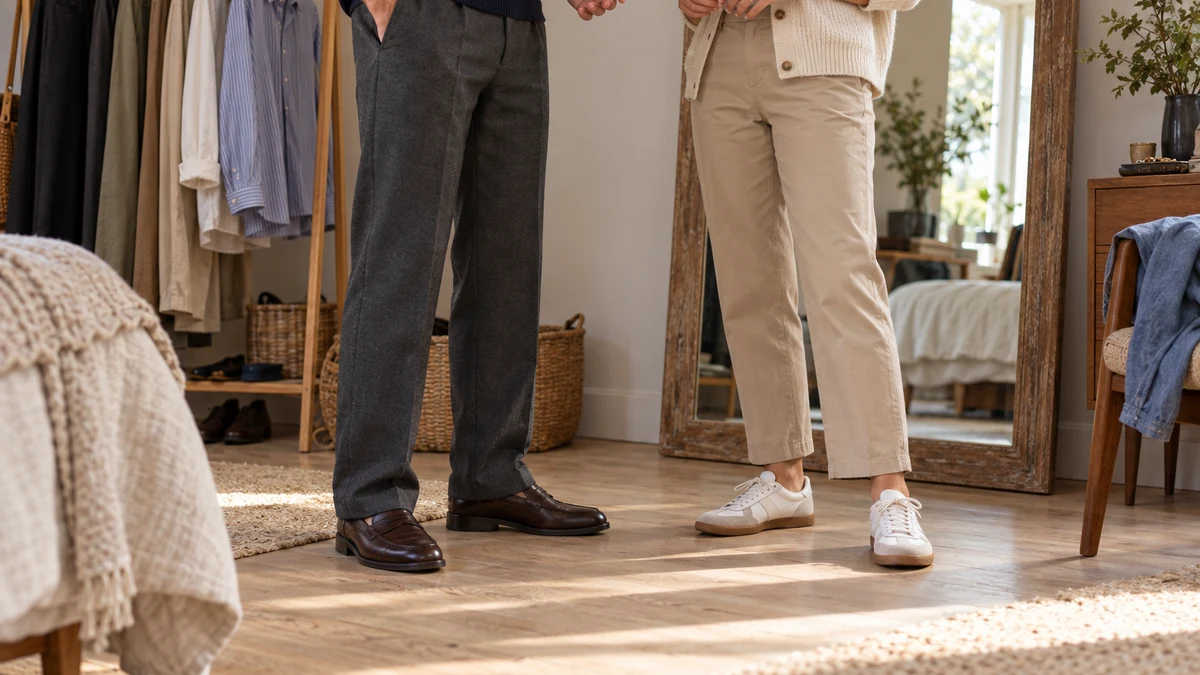
How long should straight leg trousers be? For a full-length pair, start with the back hem clear of the ground and the front just touching your shoes, with either no fold or one shallow fold. For an ankle-length pair, choose a hem that finishes around the ankle bone. Neither length requires heels.
The useful question is not whether your legs need to look longer. It is whether the trouser opening meets your footwear in a way you like, without catching, dragging or restricting your stride. A crisp cotton trouser and a fluid wool pair can need different lengths, even when both are labelled straight leg.
Before committing to an alteration, compare the same trousers at two lengths with your usual shoes. Keep the top unchanged and fold the hems inside. Seeing those versions on yourself makes the decision clearer than comparing product photographs styled with different footwear.
 LIVE FITTING

Choose the hem by how it meets your shoe
A trouser break is the fold that forms where the front hem meets the shoe. More length usually creates more folding, but the shoe’s height and the width of the trouser opening also affect it. Use these three starting points rather than treating one measurement as correct for everyone.
No break for a clean, uninterrupted leg
The front hem reaches the shoe without folding over it. This works particularly well with structured straight leg trousers in cotton twill or wool blends. Try charcoal trousers, a pale blue shirt and black loafers: the hem leaves the loafer’s upper visible rather than collecting over it.
A slight break for full-length softness
One shallow crease across the front gives a relaxed finish while keeping the back hem off the ground. Try navy wool trousers with a fine cream knit and leather trainers. If several folds stack above the shoe, pin the hem slightly higher and compare before deciding you want that extra length.
An ankle-length hem for visible footwear
A hem around the ankle bone creates deliberate space above a low shoe. Try olive cotton trousers with a striped jersey top and burgundy loafers. There is no required strip of bare skin: socks can fill the gap, making this length useful beyond warm weather.
Use your everyday shoes as the measuring tool
Put on the shoes you genuinely expect to wear most, including your usual socks. Fasten the trousers and let the waistband settle where it feels comfortable. Measuring while holding the waistband higher than you normally wear it can leave the finished trousers unexpectedly long.
With loafers, check that the hem does not repeatedly catch behind the heel as you walk. With trainers, look at the fabric above the tongue: a substantial upper can push the trouser front upwards. A length that falls smoothly over a low leather trainer may bunch over a padded running shoe.
For ankle boots, check the trouser opening as well as the length. The fabric needs enough room to fall over the boot shaft without gripping it. Our guide to ankle boots with cropped trousers explores the separate choice between a visible gap and an overlap.
Four outfits that show the length choices
Office trousers with loafers
Choose midweight grey straight leg trousers, a navy merino crew neck and black penny loafers. Start with no break so the trouser crease stays clear and the shoe remains visible. A navy sock makes the exposed area feel connected to the knit, while a grey sock keeps attention on the trouser line.
For cold mornings, add a knee-length wool coat. Check the hem again with the coat on and your bag packed, then walk normally. If you prefer a softer finish, allow one shallow front fold rather than shortening the trousers further.
Weekend cotton trousers with trainers
Pair ecru straight leg cotton trousers with a washed blue sweatshirt and low-profile white trainers. An ankle-length hem gives this casual outfit a crisp edge; a full-length, no-break version feels more continuous. Both work, so choose according to whether you want the shoes or trousers to draw attention.


On wet days, use a length that stays clear of puddles rather than relying on a thicker sole to rescue a dragging hem. If you like the pale combination but want help choosing shades, see our examples of wearing cream and white together.
Winter wool trousers with ankle boots
Try chocolate wool trousers, a tobacco roll neck and dark brown ankle boots. Let the hem overlap the boot shaft and fall freely, with little or no folding over the instep. Sit down to check that the overlap still gives the coverage you want when the trousers rise.
If the hem catches on the boot, try a narrower boot shaft before altering the trousers. Shortening alone may expose the exact point where the two garments snag. For extra warmth, wear long socks underneath rather than adding length that trails outdoors.
Evening trousers with flat shoes
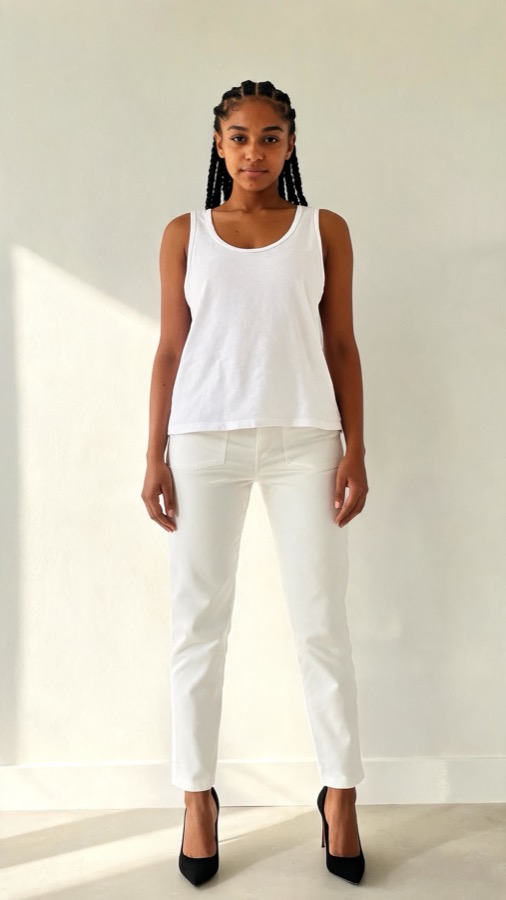
Wear black fluid straight leg trousers with a plum satin blouse and square-toe flats. Start with the hem touching the shoe lightly, then check the back carefully: soft fabric can collapse around the heel. A slightly shorter, no-break finish keeps the shoe visible without requiring a higher heel.
If you switch to heeled shoes for another occasion, expect the hem to look shorter. That can still be intentional. For a pair mainly worn with flats, prioritise the flat-shoe length instead of accepting a dragging hem for occasional heel wear.
Check fabric and movement before altering
Fabric changes how a hem behaves. Firm cotton holds folds visibly, while fluid cloth may settle around the shoe. Follow the care label before permanent alterations, particularly for washable trousers that may shrink. Let the fabric dry fully and press it before marking the final length.
Fold the excess inside and secure it with suitable clips for a stationary comparison. Remove clips or pins before walking if they could scratch or catch. For a movement check, use a safely secured temporary hem or ask a tailor to baste it.
Check the front, side and back, then sit and climb a step. Explain the finish you want to a tailor, such as no break with these loafers, rather than requesting an arbitrary number of centimetres off. Bring the shoes and have both legs checked.
Common questions
Should straight leg trousers cover your shoes?
They can cover part of the upper, but they do not need to hide the whole shoe. Full-length trousers can touch the instep with no break or a slight break. Keep the back hem off the ground and check that it does not slip beneath your heel.
Can straight leg trousers finish above the ankle?
Yes. A cropped finish works with loafers, trainers and boots when the gap or overlap is intentional. Fold the hem first and compare it with an ankle-bone length. In cold weather, add socks or choose boots that meet the hem comfortably.
Can one trouser length work with flats and heels?
Yes, especially when the difference in shoe height is modest. Fit the hem to the lower shoes so it cannot drag, then check whether you like the extra shoe showing with heels. For substantially different heights, separate lengths are more practical than one compromised hem.

5 thoughts on “How Long Should Straight Leg Trousers Be? Hem Examples”